‘And Not Much More’: Inside the Oil & Gas Industry’s Campaign Against Methane Regulations
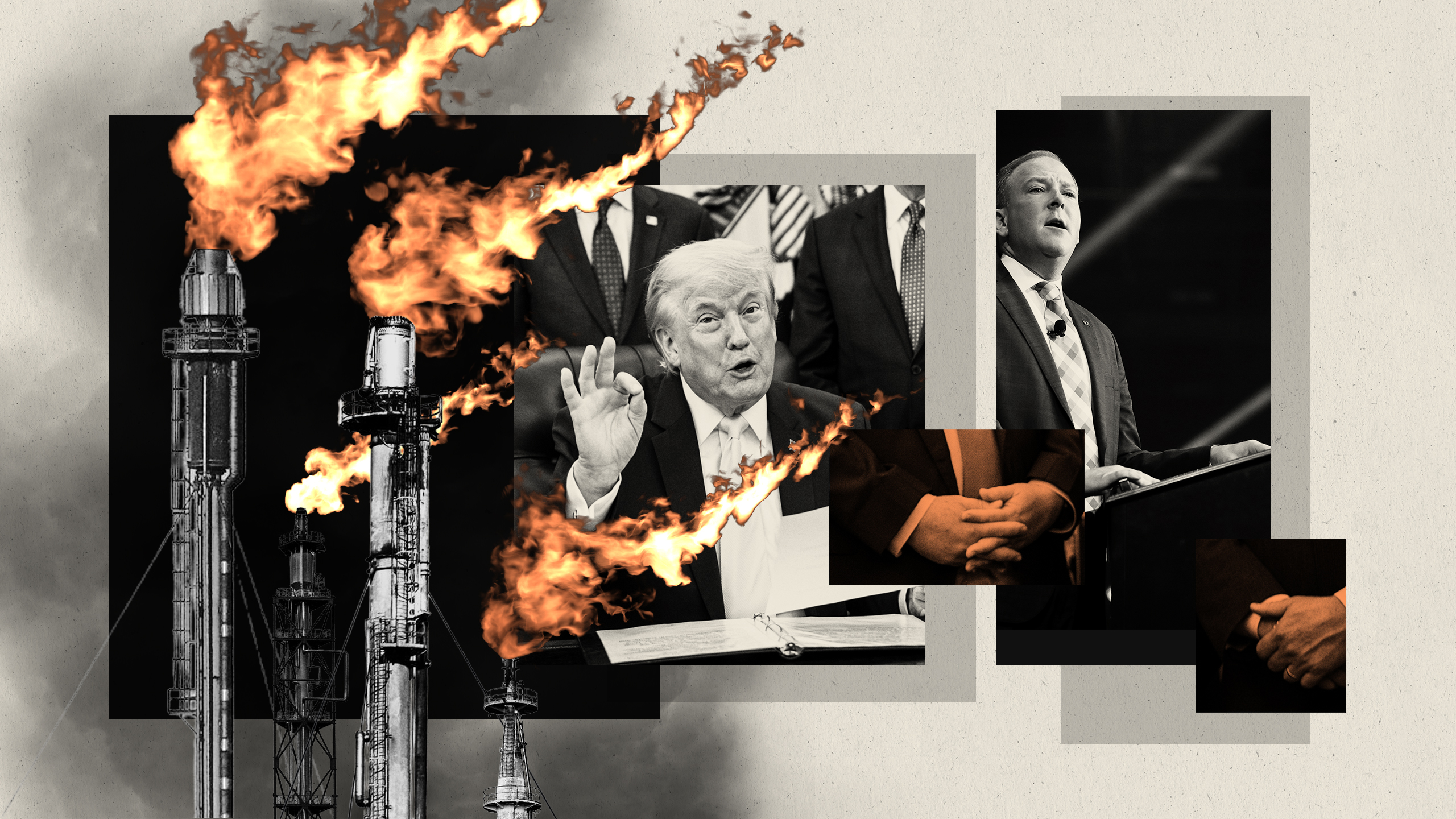
Corporations are working with the Trump administration to maintain the pretense of regulation while gutting any provisions with actual teeth.
- Takeaways
- History
- Avoiding Accountability
- Repeal vs. Reconsideration
- Loopholes
- Rewriting Regs
- Preventing Waste
- Fuzzy Math
- Weakening Int'l Standards
- Appendices
Top Takeaways
- Industry communications that were never meant to be made public, FOIA records, and statements from oil & gas executives reveal corporations’ strategy on methane: publicly state general support for regulation, then maneuver behind the scenes to avoid actual accountability.
- Working closely with the second Trump administration and congressional Republicans, industry groups succeeded in neutralizing the first direct charge the U.S. government has ever assessed on greenhouse gas emissions. Now, they’re on the cusp of eviscerating the Biden administration’s landmark methane rule.
- Industry is also pushing changes to Biden-era reporting requirements, which it feared would force operators to provide a fuller accounting of their methane emissions.
- Under Trump, EPA has granted oil & gas interests remarkable access, meeting with them to discuss the methane rules at least three dozen times in the administration’s first year.
- There will likely soon be very few federal regulations on methane pollution from the oil & gas sector, despite the fact that the powerful greenhouse gas is responsible for nearly one-third of global heating to date.
For years, U.S. oil & gas corporations have portrayed themselves as responsible operators striving to reduce methane emissions and as good-faith partners helping the government regulate the potent greenhouse gas. In reality, they fought mandatory requirements for as long as they could, then worked to delay, defang, and carve out exceptions to the rules that followed.
The result: Two decades after the fracking boom began and nearly a decade after the Obama administration finalized the first federal methane regulation, the United States emitted more of the heat-trapping pollutant from its oil & gas sector in 2025 than any other country in the world and more than the next two nations combined.
A Fieldnotes investigation based on internal trade association materials, records obtained via the Freedom of Information Act, and public statements from oil & gas leaders reveals how industry has continued to work behind the scenes to eviscerate regulations during the second Trump administration.
Industry’s twin arguments have long been that it is capable of policing itself and has an overriding financial incentive to do so. Neither stands up to scrutiny: the former is disproven by history and the latter by the economics of the most productive U.S. oilfields. But with President Trump desperate to increase oil & gas production and promote “energy dominance,” even these disingenuous defenses are no longer necessary. Administration officials have granted oil & gas interests remarkable access as they gut rules that had been tightened under President Biden. Records show trade groups and corporations discussed methane regulations with U.S. Environmental Protection Agency personnel—from Administrator Lee Zeldin down to rule-writing staff—at least 38 times during the administration’s first year, or three times a month on average. As one oil lobbyist1 boasted in private, industry now has “the keys to the kingdom.”
While oil & gas corporations originally opposed any regulation of methane, most now want to keep some rules in place, but only on their own terms—with their own math and without any strict requirements, meaningful third-party monitoring, or financial penalties that would hold them to account. In short, they want to claim they’re well-regulated without being subject to rules with any teeth and say they’re cutting emissions without having to prove it.
As the strategy was described in notes from a closed-door meeting of industry executives in 2017: “You begin by doing things voluntarily and then that (and not much more) becomes the regulation.”
Oil & gas corporations want Americans to believe that weak rules riddled with loopholes are enough. Clearly, they are not. Cutting methane pollution from the oil & gas sector is one of the most effective levers for reducing near-term warming, yet corporations have successfully prevented federal officials from pulling it, and continue to do so to this day.
Fieldnotes reached out to industry and regulatory stakeholders ahead of publication to offer a chance to comment on our findings. Several took issue with the characterizations of their policy goals, but none refuted the specific factual claims on which those characterizations rest.
This investigation provides a brief history of the oil & gas industry’s stance on methane regulation, followed by a detailed account of how key players are working with the second Trump administration to undermine Biden-era rules, namely:
- EPA’s Waste Emissions Charge (aka the methane fee or methane tax), the first direct charge the federal government has ever imposed on greenhouse gas emissions;
- EPA’s OOOOb/c rule (pronounced "Quad O"), limiting leaking, venting, and flaring;
- EPA’s Greenhouse Gas Reporting Program, specifically Subpart W; and
- Bureau of Land Management’s Waste Prevention Rule, which charges royalties on gas that is wasted or “avoidably” lost.
In addition, Fieldnotes is providing a brief overview of the methane rules put in place by the European Union on imported liquified natural gas. Also included are several appendices:
- A regulatory tracker, tracing rulemakings and litigation;
- Additional information on key oil & gas trade associations; and
- Links to the FOIA records supporting this investigation.
A History of Subversion
Oil & gas corporations have known for decades that they have a methane problem. Methane is a greenhouse gas that traps about 80 times as much heat as carbon dioxide over a 20-year time period. As early as the 1980s, industry groups downplayed growing evidence of methane’s potency and minimized scientists’ warnings that oilfield emissions pose a serious climate risk as they sought to position natural gas as a greener alternative to coal.
In the early 2000s, U.S. production skyrocketed as horizontal drilling and fracking led to a shale boom. As drilling surged, so did methane emissions. Upstream operators were leaking, venting, and flaring massive amounts of gas, and the methane problem became impossible to ignore. In 2016, President Obama’s EPA finalized the country’s first federal regulations directly addressing methane pollution from the oil & gas sector.
In the years that followed, oil & gas trade groups used two lines of reasoning to push back on the regulations. First, they claimed the rules were unnecessary because corporations were already handling the problem on their own. “Let’s not get unreasonably concerned about [methane], because the industry has been addressing it,” Erik Milito, then the American Petroleum Institute’s vice president of upstream policy, argued in 2016. He and others would later point to efforts like The Environmental Partnership, a voluntary methane-reduction initiative launched by API the following year, as proof.
But an email unearthed by a congressional investigation reveals the partnership wasn’t a sincere effort to reduce emissions, but rather a ploy to delay and minimize mandatory requirements. “The hope - but far from the certainty - is to stave off future regulation,” wrote a BP executive describing the group’s inaugural meeting in 2017. “This program alone, conceded Melito [sic], may not stave off regulation, but it would provide the industry with ammunition to help us better mitigate/mold regulation when it does come… You begin by doing things voluntarily and then that (and not much more) becomes the regulation.”
"The hope - but far from the certainty - is to stave off future regulation." BP Executive Describing the Goal of API's Environmental Partnership
The second rationale industry put forth was that gas is a valuable commodity, so operators are already motivated to prevent waste. A coalition of about two dozen trade groups made this argument in a 2019 letter to EPA, writing, “The oil and natural gas industry has a pure economic incentive to prevent every molecule of ‘pollutant’ from escaping to the atmosphere.”
But in many cases, this simply isn’t true. In places like the Permian and the Bakken, oil is the main product and the associated gas that comes up along with it is a byproduct. The cost to capture this associated gas often exceeds the value of selling it. Months earlier, Ron Ness, a trade executive who leads one of the trade groups that sent the aforementioned letter, offered a candid assessment behind closed doors. In North Dakota’s Bakken, “we’re just flaring a tremendous amount of gas,” he said. “This pesky natural gas… the value of it is very minimal.”
At industry’s urging, the first Trump administration rolled back the Obama-era rule. But that didn’t stop the mounting pressure to address methane. In private, Ness warned that even North Dakotans supportive of the oil & gas industry were fed up with all the flaring. “You run out of bullets after five to seven years [of] saying, ‘well, we’re going to be building this and we’re going to be doing this,’” he said. “All people see is that flare.”
Around the same time, corporations were also beginning to face increased scrutiny from the European Union. In 2020, the European Commission adopted the E.U. Methane Strategy and began drafting the bloc’s first regulation aimed at reducing methane emissions from the energy sector.
By the time the Biden administration came in and declared it would create new rules to reduce methane pollution from the oil & gas industry, there was a growing realization that some level of regulation had become inevitable. In early 2021, API shifted its internal position and said it would now support direct regulation. In an email to members, the trade lobby’s CEO, Mike Sommers, explained that the about-face was “a key precursor to increasing public confidence in our industry's performance while also signaling to [the] Biden Administration that API needs to be at table as they quickly shift in federal regulatory policy.” EPA and the Bureau of Land Management (BLM) went on to finalize four rules regulating methane emissions from oil & gas.
During the Biden administration, API flip-flopped from opposing regulation to purportedly embracing it. But while API described itself to Biden’s EPA as a “good-faith partner” in crafting its methane rules, the trade group repeatedly attempted to delay, weaken, and carve out loopholes. Likewise, another major trade association, the American Exploration & Production Council (AXPC), publicly said its members were “committed” to reducing emissions and supported “effective and reasonable” regulations, but privately worked to dismantle those regulations, even as the group knew the volume of gas its members were flaring was actually increasing. Other groups, like a coalition led by the Independent Petroleum Association of America (IPAA), fought federal requirements tooth and nail.
Asked for comment, AXPC president and CEO Anne Bradbury said the group “strongly disagrees with the characterization that it has sought to ‘dismantle’ methane regulations. American oil and gas producers have achieved significant methane emissions reductions, and AXPC has consistently supported solutions to advance meaningful environmental progress through evidence-based, technically sound regulations regardless of the administration in power.”
However, at least one prominent former member seems to disagree. At the end of 2024, ExxonMobil left the trade organization, noting, “AXPC has taken positions that are inconsistent with ExxonMobil’s approach, including pushing back aggressively on the Biden Administration’s methane regulations.”
Since Trump returned to the White House and Republicans retook complete control of Congress in 2025, oil & gas corporations have largely backed away from their previous claims. Instead, they now contend that striking down key parts of the Biden-era rules will lower their costs and allow them to “unleash” production.
The industry is not a monolith, and there are some nuances to what different players want. But most are working to preserve a veneer of regulation while gutting accountability mechanisms and provisions that would require corporations to actually make substantial changes.
Avoiding Accountability
There are few things the oil & gas industry hates as much as the Waste Emissions Charge (WEC), also known as the methane fee or methane tax. Passed into law as part of the Inflation Reduction Act in 2022, the WEC is the first direct charge that the federal government has ever imposed on greenhouse gas emissions. During the early days of the second Trump administration, killing it was a top industry priority.
EPA finalized its WEC rule in November 2024. The rule, which has since been revoked, would have required oil & gas facilities that emit more than 25,000 metric tons of carbon dioxide equivalent per year to pay a fee on excess emissions. The fee was set to start at $900 per metric ton for 2024 and rise to $1,500 in later years.
On one hand, the methane fee set a significant precedent. On the other, it contained so many loopholes that few corporations would have ended up paying any penalty.
That didn’t stop oil & gas industry groups and Republican-led states from suing soon after the Biden-era rule was finalized. And it didn’t stop the GOP-controlled House and Senate from approving a Congressional Review Act resolution in February 2025, which nixed the rule.
But while Republicans had killed the rule implementing WEC, the requirement still existed in the underlying statute. The oil & gas industry urged its allies in Congress to address this through reconciliation.
In the spring of 2025, as the Republicans’ reconciliation bill was coming together, it became clear that Congress was leaning towards delaying the methane fee, as opposed to fully repealing it. The reason: Congress was grasping for ways to offset Trump’s tax cuts, and fully repealing WEC would have decreased revenue even further.
This was unacceptable to the oil & gas industry. In public, API responded to a House committee’s proposal to delay WEC by saying it was “hopeful that the final package includes the permanent repeal of the punitive ‘methane fee.’”
In private, an executive from a different trade association1 was more blunt, saying, “The desire, I think, on the part of most Republicans—and in some cases, the promise—was to eliminate that thing… They need to get a little creative about figuring out how to get this done.”
" The desire, I think, on the part of most Republicans—and in some cases, the promise—was to eliminate that thing… They need to get a little creative about figuring out how to get this done." Trade Group Executive Discussing the Methane Fee
To that end, industry lobbyists leaned on Republicans on the Senate Environment and Public Works Committee, who in turn appealed to EPA’s Office of Air and Radiation to pressure the Congressional Budget Office to decrease its estimate of how much a full repeal would cost.
Ironically, while Biden’s EPA was finalizing the WEC rule, oil & gas trades complained loudly that it would impose high costs on energy producers (even as the agency noted that many large companies would qualify for exemptions and were unlikely to pay any penalties). Yet as Congress scrambled to make the math work on the tax cuts, industry lobbied behind the scenes to downplay the costs it had once emphasized.
One lobbyist1 described those efforts, saying that senior political appointees within EPA’s Office of Air and Radiation were in touch “in a somewhat backchannel fashion” with the Senate EPW Committee. “They're working to generate enough data from EPA to sort of help make the case that the cost of a repeal would be less than the Congressional Budget Office thinks it would be,” the lobbyist explained. “That’s really central for us in the Senate.”
Public records back this up, showing Aaron Szabo, EPA’s assistant administrator for the Office of Air and Radiation, met and exchanged emails with Republican staff on the Senate EPW Committee and analysts within the Congressional Budget Office in the months leading up to the reconciliation bill’s passage.
Asked for comment, EPA spokesperson Carolyn Holran said that the agency “provides technical assistance to Senate EPW as requested, that is no secret.”
Congress ultimately delayed the methane fee by 10 years, but much to industry’s chagrin, did not fully repeal it. Unless Congress votes to amend the law again, WEC will go into effect in 2034. For the time being, however, industry doesn’t have to worry about it, and Republicans didn’t have to fully offset the cost of its repeal in their tax bill.
Repeal vs. Reconsideration
With the WEC delayed, the oil & gas industry set its sights on weakening the remaining Biden-era methane rules, chief among them OOOOb/c.
The OOOOb/c rule, published in March 2024, requires upstream and some midstream oil & gas operators to eliminate or minimize leaking, venting, and flaring of methane and volatile organic compounds. OOOOb applies to new sources, while OOOOc applies to existing sources. The latter is the first time EPA has ever regulated methane from existing oil & gas facilities.
Larger oil & gas trades, like API and AXPC, have consistently pushed the Trump administration to reconsider OOOOb/c, as opposed to fully repealing it. Initially, the trades that primarily represent smaller producers were divided. They eventually landed on reconsideration—or, as one trade group1 which put a finer point on it described in an email to members, “‘reconsideration’ of the rule leading to changes that would alter it dramatically enough as to essentially gut the rule.”
"‘Reconsideration’ of the rule leading to changes that would alter it dramatically enough as to essentially gut the rule." Trade Group Describing Its Goal for EPA's Rulemaking
Part of the reason industry has united behind this strategy is it believes it will be faster. “Reconsideration allows you to go in and do things to change the regulations with less of a rulemaking framework around it,” explained a different executive1 on an internal call last spring. “It's faster than starting from square one. And that's why we've been trying to get them to do that.”
But the reconsideration process thus far has been beset by delays. At first, industry was hoping EPA would finalize a new rule by the end of 2025, allowing the Trump administration to defend it throughout the full course of the litigation that will inevitably follow. Later, in a September 2025 letter, API wrote that it “strongly recommends that the rulemaking be completed no later than mid-2026.”
Despite industry’s urging, EPA keeps pushing the timeline back. Last fall, the administration said it would propose the new rule in November 2025 and finalize it in July 2026. Those deadlines came and went. More recently, the administration said it would propose the new rule in July 2026 and finalize it in July 2027. In mid-August, the agency sent the proposed rule to the White House’s Office of Management and Budget for review.
Inventing Loopholes
While the Trump administration’s broader reconsideration of OOOOb/c is still pending, it has made a few modifications in the meantime. EPA delayed some compliance deadlines by 18 months—until January 2027—and finalized changes to two fairly narrow aspects of the rule.
But significant delays in the rulemaking process allowed one of the regulation’s key provisions to take effect this spring. Beginning May 7, 2026, the rule prohibits routine flaring of associated gas for new wells, except for in a few narrowly-defined circumstances, causing a great deal of angst in some segments of the industry.
In late April, Continental Resources founder Harold Hamm’s trade association, the Domestic Energy Producers Alliance, described this as “a narrow regulatory cliff” and urged its members to contact EPA and Congress about the looming deadline.
Three companies—Continental Resources, Chord Energy, and Kraken Oil and Gas Partners LLC—met with EPA and wrote letters asking the agency to modify the rule to allow operators to continue routine flaring in some circumstances. At least one state trade association1 discussed the issue with Szabo, assistant administrator for EPA’s Office of Air and Radiation, and Rep. Julie Fedorchak (R, N.D.) asked Zeldin about it during a Congressional hearing.
In response, Szabo released a memo on Apr. 30, 2026, which said EPA believes that the regulations currently on the books allow many operators to, in effect, continue routine flaring. In fact, Szabo’s memo contradicts the current regulations. He claims that inadequate pipeline capacity—a widespread and lasting circumstance in multiple basins—counts as a “temporary interruption in service,” enabling operators to continue flaring under what was intended to be a narrow exception written into the rule.
While Zeldin and Szabo have been careful to frame the memo as guidance clarifying the existing regulation, others have been more candid. On a podcast, Jarrod Agen, executive director of the National Energy Dominance Council, described it as a “flaring waiver we just announced that can help with production.” Asked for comment, Holran, the EPA spokesperson, said Szabo’s memo “reaffirm[s] that in instances raised by stakeholders, owners, and operators, they may continue routine flaring of associated gas at new oil wells after the flaring phase out deadline under current regulations.”
While Szabo’s memo isn’t exactly what the oil & gas industry asked for—Continental, Chord, and Kraken all made it clear they thought a revision to the rule was necessary—it does give them the green light to continue routine flaring in many common situations. Two trade groups1 counted this as a win in internal communications.
This issue will likely be moot after EPA completes its broader OOOOb/c reconsideration, which is expected to give operators wide latitude to flare.
Rewriting Regulations
To understand how oil & gas corporations are pressing EPA to gut OOOOb/c, it’s worth zooming in on a few topics, namely:
- marginal wells;
- routine flaring;
- pneumatic controllers; and
- the Super Emitter Program
Marginal Wells
Wells that produce 15 barrels or less of oil equivalent (BOE) or 90,000 cubic feet of natural gas per day are known as marginal wells. They make up only about 6 percent of production, but account for around half of all methane emissions from oil & gas well sites in the United States.
Industry often talks about marginal wells as if they’re all run by small businesses, but that’s not the case. According to an Environmental Defense Fund analysis, nearly half of all marginal wells are owned by just 93 corporations, each of which controls more than 1,000 wells. In contrast, companies that own fewer than 10 operating sites—the kind of “mom and pop” operations industry likes to tout—together control just 4 percent of marginal wells.
Exempting marginal wells from regulation is the top priority for those oil & gas corporations focused solely on upstream exploration and production (i.e., those without a refining division), which are known as “independents” within the industry, a term that belies the reality that many are valued at billions of dollars. “The environmentalists' point has always been that even if those tiny wells may be emitting just a little bit, you add them all together and you've got a big problem,” said one trade executive1 during an internal call. “We, of course, are in the business of protecting these wells.” The executive went on to describe regulations on these wells as “a train wreck that we can’t let happen if we can avoid it.”
An IPAA-led coalition of about two dozen trade groups known as the Producers Association is pushing EPA to create a separate category for marginal wells and to shield them from regulation. One state trade1 wrote in an internal email: “We and others in the coalition broadly believe that there should be exemptions for marginal wells. While there has been considerable discussion as to where those lines of distinction should be drawn, [our trade group] has firmly held that wells producing 15 barrels of oil equivalent (BOE) or less per day should be largely exempt from the rule requirements, [OOOOc] (existing sources) in particular.”
The IPAA-led group ultimately asked the agency to allow marginal wells that emit less than 20 tons per year of methane “to vent and/or flare without restriction” and to allow marginal wells that emit more than 20 tons per year to flare routinely whenever alternatives are not technically or economically feasible. The National Stripper Well Association (NSWA), went even further, telling EPA all stripper wells, which are typically marginal wells, should be exempt from OOOOb/c.
During a conference call with industry representatives last year, IPAA executive Lee Fuller expressed amazement at how willing EPA was to consider the coalition’s suggestions on how to shield marginal wells. Describing a discussion with agency staff, Fuller said that “it was one of the more fascinating meetings that we've ever had, just because they were suddenly willing to talk to us. And they were also suddenly willing to talk about things that we've been trying to get them to do for years, and they've never even let it kind of come onto the radar screen.”
"It was one of the more fascinating meetings that we've ever had, just because they were suddenly willing to talk to us." Lee Fuller, IPAA Executive
Asked for comment, IPAA communications chief Abby Miller said the group’s focus has long been on “ensuring regulations are workable for low-production and marginal wells” and that it has “consistently emphasized practical emissions reductions and accurate data rather than one-size-fits-all requirements.” (After publication, Miller disputed that IPAA leads the Producers Association, instead claiming it is simply a member. Other members of the group, however, have described it in internal communications as “IPAA-led” and as “the IPAA coalition”—something Miller declined to address.)
Jim Elliott, the lawyer who represents the Producers Association, said he “disagree[d]” with the “characterization that the associations' objective is to ‘hollow out’ methane regulations.” He said that the group’s “position has consistently been that EPA regulations should provide appropriate environmental protection while recognizing operational and economic differences within the industry and, importantly, remain within the legal authority Congress granted EPA under the Clean Air Act.”
Larger oil & gas trade groups seem to be largely aligned with IPAA. At a May 2026 conference of state oil & gas regulators, AXPC’s senior vice president of policy, Wendy Kirchoff, said, “It's been argued, and we sympathize, that for smaller operators, the compliance burden is disproportionate. Many of these provisions were designed with large unconventional operations in mind and don't reflect the reality of a marginal well operator.” API is also asking EPA to ease requirements on low-producing wells.
Industry-friendly state regulators have joined the chorus, telling EPA that regulating marginal wells could cause owners to walk away from them, “orphaning” the wells and dumping the responsibility for plugging and cleaning them up onto the states.
In mid-September, ProPublica obtained a copy of EPA’s draft rule and reported that the Trump administration plans to “drastically weaken” requirements for low-producing wells.
Still, many in the oil & gas industry are concerned that a future administration could reinstate regulations on marginal wells. As one trade executive1 warned, “If you don't come out of [EPA’s rulemaking] process with something there that can take away their ability to regulate marginal wells down the road, that's the next round.”
To address this fear, several trade associations have been lobbying congressional Republicans for a “legislative fix.” On May 21, Rep. August Pfluger (R-Texas) and Sen. Cynthia Lummis (R-Wyo.) introduced a bill that would amend the Clean Air Act to exempt marginal wells from methane regulations. In an internal newsletter, one trade group1 claimed credit, noting it had “worked closely in the development of this legislation” with three other trade associations: IPAA, NSWA, and Harold Hamm’s group, the Domestic Energy Producers Alliance (DEPA).
A recent ProPublica investigation found that exempting marginal wells would especially benefit billionaire Trump donor Jeffery Hildebrand, who owns Hilcorp.
Routine Flaring
The oil & gas industry has long recognized that routine flaring is a problem, both for the climate and for its social license to operate. In a 2020 internal email obtained via a congressional investigation, a Shell employee wrote to the corporation’s president of U.S. operations: “We can’t say it so bluntly, but if you need to vent methane and routinely flare gas, then you don’t really have a business model that works in a world striving to achieve the goals of the Paris Agreement.”
The majors have pushed for delays and exceptions to the Biden-era provisions that ban routine flaring, but they haven’t fully rejected them. Many smaller independents, on the other hand, are working to reverse them.
As mentioned previously, the Producers Association—a group of about two dozen trades—has asked the agency to allow marginal wells that emit less than 20 tons per year of methane “to vent and/or flare without restriction” and to allow marginal wells that emit more than 20 tons per year to flare routinely whenever alternatives are not technically or economically feasible.
Harold Hamm’s company, Continental, has argued that operators should be able to continue flaring routinely if they assert there are no other “economically feasible” options, which would be a significant loophole.
Continental did not respond to a request for comment.
Pneumatic Controllers
At many oil & gas sites, valves are operated by natural gas-driven pneumatic controllers, which vent methane directly into the atmosphere. Replacing these controllers with zero-bleed options that don’t release methane is widely considered low-hanging fruit when it comes to cutting emissions, but the oil & gas industry has opposed many provisions that would require operators to do so.
API, for example, has said it supports reducing emissions from pneumatic controllers, but lobbied against zero-emitting standards. During the Biden administration’s rulemaking process, API argued that EPA shouldn’t force oil & gas sites with fewer than 15 controllers or without access to the electrical grid to switch to zero-bleed devices. Instead, the trade group said they should be allowed to use low-bleed or intermittent, as opposed to high-bleed, controllers. By API’s own estimate, 72% of production sites lack access to the electrical grid, meaning the majority of sites would be exempt from zero-emitting requirements under the trade group’s recommendation.
In the final rule, EPA created a carveout allowing sites in Alaska without access to the electrical grid to continue using low-bleed controllers, but required sites throughout the rest of the country to switch to zero-emitting options. The agency also rejected industry’s request to exempt sites with fewer than 15 controllers.
API seemed to accept the outcome of the rulemaking in this regard. While the trade group submitted two petitions for reconsideration of the OOOOb/c rules, it didn’t challenge provisions requiring the phase-out of natural gas-driven pneumatic controllers for permanently installed equipment.
But things changed when the Trump administration took over. In September 2025, API submitted a letter to EPA asking for additional reconsideration. “Issues presented in this letter have been previously raised in the original reconsideration petitions submitted in 2024,” API claimed, “However, we have broadened the scope and elaborated on the importance of these priority reconsideration issues.”
Now, API is reprising its argument that sites with fewer than 15 controllers or without access to the electrical grid should be exempt from the requirement to switch to zero-emitting controllers. This would mean a massive number of marginal wells and wells in remote areas of the Permian, Bakken, and Powder River basins would be allowed to continue using pneumatic controllers that vent methane directly into the atmosphere.
This is a prime example of API flip-flopping. The industry group was resigned to certain rules under a Democratic administration, but now that a Republican administration has given it an opening to gut those rules, API is taking it.
API did not respond to a list of detailed questions.
AXPC has taken a similar stance, telling EPA in February 2025 that the “zero-emitting standard [for process controllers] is challenging in some areas and may be an environmental disbenefit.”
The Producers Association claims that implementing the Biden-era OOOOb/c rule will cause the shut-in of about 300,000 marginal wells, primarily as a result of requiring operators to replace natural gas-driven pneumatic controllers and implement leak detection and repair (LDAR) programs. The group of about a dozen trades has asked EPA to completely eliminate the requirement that operators switch to zero-bleed controllers.
Super Emitter Program
The oil & gas industry seems truly terrified of meaningful third-party monitoring under the Super Emitter Program, a OOOOb/c provision that allows EPA-approved observers to report major leaks with a rate of over 100 kilograms per hour. Many would like to see the program eliminated completely.
API sought to hobble the initiative from the start. During the Biden administration’s rulemaking, the leading trade group argued:
- Corporations should be notified of third-parties’ monitoring plans at least seven business days before the monitoring was to occur.
- Third-parties should be barred from sharing their data publicly, including on social media.
- EPA should only release the data in aggregated reports that anonymize operators (with a few caveats).
After the Biden-era rule was finalized, API and AXPC petitioned the agency for reconsideration, writing in May 2024, “We believe the Super-Emitter Program serves an important function, and we do not advocate for its removal from the Final Rule,” but that it “should not trigger any mandatory action under [OOOOb/c].”
With the Trump administration now in power, API’s position on the Super Emitter Program is unclear. But public records show AXPC has flip-flopped and is eager to kill the program.
In slides for a May 2025 meeting with EPA, AXPC wrote that the program “should be removed from OOOO regulatory requirements,” and if retained at all, should be modelled after the Natural Gas STAR program. That program, launched by the American Gas Association and EPA in 1993, was completely voluntary, imposed no obligations on participating companies, and was described by industry as a way to avoid regulations while burnishing its image.
Other trade groups have been vehemently opposed to the Super Emitter Program since the beginning. Before the OOOOb/c rule was finalized, one regional trade executive1 had this to say: “I’m falling on my sword about that Super Emitter Program. If that ever gets into law, I’m out... I can hardly wait to take that on because that is so unlawful.”
The IPAA-led Producers Association has also gone on record asking EPA to eliminate the program completely.
Preventing Waste
While the bulk of the country’s federal methane regulations have been promulgated by EPA, BLM has also made efforts to lessen pollution from oil & gas operations on federal lands. In April 2024, BLM published a waste prevention rule aimed at reducing the amount of gas vented and flared from federal leases and charging royalties on gas that is wasted or “avoidably” lost.
BLM’s rule seems to be of particular concern for corporations that drill for oil but don’t operate refineries, which have been lobbying the Trump administration to revise or repeal it. In January 2025, AXPC sent a letter to the Interior Department asking it to modify the rule and to allow flaring when operators deem it “uneconomic” to capture associated gas. Later, in June 2025, Continental sent a letter to Interior Secretary Doug Burgum asking him to immediately rescind the rule or to create carveouts for regions that don’t have adequate pipelines.
In June, BLM proposed a rule which would expand the circumstances under which corporations can flare royalty-free, eliminate limits on that flaring, and cut many provisions from the Biden-era rule, including leak detection and repair (LDAR) program requirements. The public comment period closed at the end of August, and BLM is expected to finalize the rule in the coming months.
Asked for comment, Interior Department spokesperson Charlotte Taylor said the agency’s “goal is to provide certainty to the industry, and pave the way to more efficient, less costly energy needed to enhance the American economy.”
Fuzzy Math within the GHG Reporting Program
In addition to the advocacy efforts described thus far, the oil & gas industry has also been urging Trump’s EPA to make adjustments to methane reporting requirements.
Methane emissions from oilfields are severely undercounted. According to a 2024 Stanford study, oil & gas operations across the United States emit more than 6 million tons per year. This number is roughly three times higher than what corporations report to the federal government.
In May 2024, EPA finalized changes to the Petroleum and Natural Gas Systems section of the Greenhouse Gas Reporting Program, known as Subpart W, to try to address this discrepancy. The Subpart W rule changed the way operators are required to estimate and measure methane emissions and required them to start including types of sources that weren’t previously covered.
Behind closed doors, some in the industry expressed fear that they would be forced to report higher emissions under the new methodologies. At a trade group meeting1 in fall 2023, an analyst said that corporations were concerned the Subpart W revision would be “a major PR headache” because it would force them to re-baseline their corporate emission intensity targets. “They're like, how do we even go to our investors and explain that this is what's happening? It's not that we're increasing emissions; it's that the regulations are changing,” the analyst said.
Of particular concern was the fact that the new rule required operators to estimate and report emissions from super emitter events. “Things that had historically potentially gone unreported will now have to be reported,” the analyst explained. For example, in 2018, an ExxonMobil subsidiary had a massive well blowout in Ohio, which led to one of the largest leaks ever detected in the United States. “It's estimated at at least 50,000 metric tons of methane. If you go look at their reporting, it doesn't include that,” the analyst said. “Now, they would have to report that.”
"Things that had historically potentially gone unreported will now have to be reported." Analyst at Fall 2023 Trade Group Meeting
Other groups fretted about the changes, too. At a trade group meeting1 in fall 2025, a consultant said some companies were seeing a four- to ten-fold increase in how much methane they would need to report. At a gas group conference this past spring, another consultant said the new methodologies would result in a 16 percent increase in reported emissions for the group, even without including large release events. (It’s likely this estimate is lower because it’s for companies that primarily produce gas, not oil.)
The Biden-era rule mandated that operators use the new methodologies from 2025 on, but made them optional for reporting 2024 emissions. Some chose to use them and, despite the fears described above, actually reported lower emissions in 2024 than 2023. As ProPublica has detailed, it’s difficult to parse what portion, if any, of this decline is attributable to genuine improvements and what portion is attributable to corporations figuring out how to game the reporting system.
In March 2025, Trump’s EPA announced it was reconsidering the entire Greenhouse Gas Reporting Program, of which Subpart W is just a piece. Six months later, EPA proposed a rule that would repeal the program—with the exception of some Subpart W requirements, which it proposed suspending until 2034 (the same year WEC now goes into effect).
There are a few elements of Subpart W that were mandated in the Inflation Reduction Act, meaning EPA can’t do away with them completely. To address these elements, in March 2025, EPA said it would initiate a separate reconsideration focused solely on Subpart W. That rewrite, which the agency has discussed with industry but hasn’t proposed yet, is really a fail-safe. Oil & gas corporations know that a future administration could reinstate reporting requirements. If that happens, they’d like to tally their pollution on their own terms.
If EPA does do away with most of the Greenhouse Gas Reporting Program and delay the surviving Subpart W requirements, as it has proposed, some corporations have said they will continue cataloguing emissions. To that end, the University of Texas at Austin and Colorado State University have been working on an industry-funded “fill in” program, which they are calling openGHGRP, where polluters will be able to report emissions on a voluntary basis. This will allow corporations to claim they are being transparent, but without any real oversight or consequences if they underreport.
Weakening International Standards
As the United States was developing its methane rules under Biden, the European Union was engaged in a similar process. Just like the oil & gas industry worked to weaken the U.S. standards, it also sought to stall and soften the E.U. regulation, which is of particular import to corporations that want to sell U.S. LNG to countries within the bloc.
In 2020, the European Commission adopted the E.U. Methane Strategy and began drafting the bloc’s first rules aimed at reducing methane emissions from the energy sector. Over the years that followed, it developed a regulation that phases in measures designed to lower methane pollution from fossil fuels that are both produced domestically and imported from abroad.
In 2025, the rule began requiring European producers to eliminate or minimize leaking, venting, and flaring. Last year was also the first that importers had to start providing information on emissions associated with their cargoes.
Beginning in 2027, importers must prove that all imported fossil fuels meet E.U. or equivalent standards for methane measurement, reporting, and verification (MRV) or face fines (though the enforcement of penalties has recently been delayed). The following year, importers will need to report the methane intensity of their imported cargoes. Finally, beginning in 2030, all fossil fuels on the market in the European Union will be required to meet a maximum methane intensity, which has yet to be set by the European Commission.
On the eve of the 2024 U.S. election, Biden administration officials sent a letter to an E.U. official arguing that their regulations were equivalent to Europe’s, in effect asking her to deem oil & gas producers compliant with U.S. regulations to be compliant with the E.U. regulation, too. The European Union didn’t act on that request, likely waiting to see the outcome of the election.
After Trump was elected, some analysts believed that, while the incoming administration would likely weaken or roll back the U.S. methane rules, the E.U. rules would largely remain in place. Therefore, even if the United States didn’t require producers to track and lower emissions, corporations that wanted to sell LNG to the European Union would still continue to do so.
One consultant summed it up: “In the European Union, not in all of Europe, but [in] the E.U., the regulatory environment already requires that you have to have quantifiable, verifiable and measured emissions associated with that gas. So in other words, it's not necessarily a regulatory consideration, it is a commercial consideration.”
Industry executives, however, correctly predicted that the Trump administration would lean on the European Union and pressure the bloc to gut its regulations. At a gas industry conference in April 2025, Cheniere Energy’s director of international affairs said the E.U. measurement and verification requirements were unrealistic for U.S. corporations to comply with. “You're asking U.S. companies to do well beyond what they're required to in the United States,” he said. “The narrative then that you would tell the U.S. administration about what is being imposed on U.S. producers by Brussels—you can only imagine how that would go down the street [at the White House].” The audience chuckled.
During the second Trump administration, Interior Secretary Doug Burgum, Energy Secretary Chris Wright, and others have pushed the European Union to either scrap its regulations or exempt U.S. producers. E.U. commitments to phase out Russian gas and the closure of the Strait of Hormuz have only increased the pressure.
The U.S. oil & gas industry is fiercely opposed to the E.U. Methane Regulation and would like to be exempted from it or see it significantly weakened. Corporations and trade groups have lobbied both publicly and privately, playing on narratives that the rules endanger E.U. energy security. According to InfluenceMap, a group that traces corporate lobbying on climate policies around the world, various factions within the industry have pushed for a “stop-the-clock” delay and simplification of the rule; for outright repeal; for less stringent certification methods; for a grace period on importer obligations and grandfathering of contracts signed in the interim; to establish national MRV equivalence for U.S. fossil fuels despite the rollback of federal methane reporting frameworks; and for broad interpretation of a provision that ensures that the application of penalties doesn’t endanger energy security.
In July 2026, the European Commission issued two recommendations following intense pressure from the oil & gas industry, the United States, and other countries, including E.U. member states, Nigeria, Qatar, and Algeria. Both recommendations were intended to support “pragmatic” implementation of the regulation in light of the Iran war. One advised member states to refrain from fining importers that don’t comply with the regulation from 2027 through 2029. The other permitted less stringent certification methods for demonstrating MRV equivalence for complex supply chains. While these are significant concessions, the Commission has thus far refused to scrap or renegotiate the rules.
Appendices
Regulatory Tracker
EPA’s OOOOb/c Rule
Current status: EPA has suspended all enforcement, pushed back many compliance deadlines, and finalized Phase 1 of its reconsideration effort addressing two narrow aspects of the rule. The agency is expected to release a proposal gutting the Biden-era requirements in the near future.
Narrative: In March 2024, the Biden administration finalized the OOOOb/c rule, which required upstream and some midstream oil & gas operators to eliminate or minimize leaking, flaring, and venting of methane and volatile organic compounds. OOOOb applied to new sources; OOOOc applied to existing sources—the first time EPA has ever regulated methane from existing oil & gas facilities. The rule also created a Super Emitter Program to allow third parties to report major leaks.
Right after the Biden-era rule was finalized, oil & gas industry groups and Republican-led states sued. After Trump’s EPA announced in March 2025 that it would reconsider the rule, the case was held in abeyance. The rule technically remains in effect while the case is paused and as the reconsideration process plays out, but the Trump administration announced that it won’t be enforcing it.
In July 2025, EPA published an interim final rule (IFR) delaying many OOOOb/c compliance deadlines until January 2027. This was controversial because the agency skipped the public comment period. Environmental groups sued. This past winter, EPA re-published the rule—this time after allowing a public comment period. The environmental groups sued again and the case is ongoing.
In April 2026, EPA completed Phase 1 of its reconsideration process. Zeldin publicized the final rule as a step towards reversing his predecessors’ attempt to “regulate the oil and gas industry out of existence,” but this reconsideration was actually initiated under the Biden administration and only addressed two fairly narrow aspects of the rule. In June 2026, the Environmental Defense Fund sued.
In May 2026, a provision in OOOOb that prohibits routine flaring—the burning of associated gas during the course of normal operations—was supposed to go into effect for new wells. However, a week beforehand, EPA’s Office of Air and Radiation issued a memo which purportedly clarified the existing regulation, but actually undermined the ban and gave oil & gas operators a green light to continue routine flaring in some scenarios.
Later in May, Rep. August Pfluger (R-Texas) and Sen. Cynthia Lummis (R-Wyo.) introduced legislation to permanently exempt marginal wells from methane regulations.
Phase 2 of the reconsideration process is ongoing. In the Trump administration’s latest regulatory agenda, EPA said it planned to publish a proposed rule in July 2026 and finalize it by July 2027. In mid-August, the agency sent the proposed rule to the White House’s Office of Management and Budget for review.
In general, industry wants EPA to keep the rule in place but make significant changes that would effectively gut it. Majors and smaller independents’ positions on the rule differ in some ways. Smaller independents’ top priority is carving out a separate category for marginal wells and largely exempting them from regulation. But most in the industry are united in pushing for laxer requirements related to flaring and pneumatic controllers and opposing meaningful third-party monitoring under the Super Emitter Program.
Rulemakings
Biden Rule
- Full Title: “Standards of Performance for New, Reconstructed, and Modified Sources and Emissions Guidelines for Existing Sources: Oil and Natural Gas Sector Climate Review”
- RIN: 2060-AV16
- Docket: EPA-HQ-OAR-2021-0317
- Federal Register: FRL-8510-01-OAR (Mar. 8, 2024)
Trump 2.0 Rule to Extend Compliance Deadlines
- Full Title: “Extension of Deadlines in Standards of Performance for New, Reconstructed, and Modified Sources and Emissions Guidelines for Existing Sources: Oil and Natural Gas Sector Climate Review Final Rule”
- RIN: 2060-AW61
- Docket: EPA-HQ-OAR-2025-0162
- Federal Register:
- FRL-12675-01-OAR (July 31, 2025)
- FRL-12675-02-OAR (Dec. 3, 2025)
Trump 2.0 Reconsideration Phase 1
- Full Title: “Reconsideration of Standards of Performance for New, Reconstructed, and Modified Sources and Emissions Guidelines for Existing Sources: Oil and Natural Gas Sector Climate Review”
- RIN: 2060-AW35
- Docket: EPA-HQ-OAR-2024-0358
- Federal Register: FRL-12031-02-OAR (Apr. 9, 2026)
Trump 2.0 Reconsideration Phase 2
- Full Title: “Additional Reconsideration of Standards of Performance for New, Reconstructed, and Modified Sources and Emissions Guidelines for Existing Sources: Oil and Natural Gas Sector Climate Review”
- RIN: 2060-AW73
- Docket: N/A (proposed rule not yet published)
- Federal Register: N/A (proposed rule not yet published)
Litigation
- State of Texas, et al v. EPA, et al (Case No. 24-1054)
- Republican-led states and oil & gas groups sued over Biden’s OOOOb/c rule. The case is currently held in abeyance.
- Environmental Defense Fund, et al v. Lee Zeldin, et al (Case No. 25-1164)
- EDF and other environmental groups sued over Trump’s first rule extending OOOOb/c compliance deadlines. The case was dismissed after the Trump administration put out a second rule, this time after accepting public comment.
- Environmental Defense Fund, et al v. Lee Zeldin, et al (Case No. 25-1275)
- EDF and other environmental groups sued over Trump’s second rule extending OOOOb/c compliance deadlines. The case is ongoing.
- Environmental Defense Fund, et al v. Lee Zeldin, et al (Case No. 26-1152)
- EDF and other environmental groups sued over Trump’s OOOOb/c phase 1 reconsideration. The case is ongoing.
EPA’s Subpart W Rule
Current status: EPA has proposed repealing most of the Greenhouse Gas Reporting Program, with the exception of some Subpart W requirements, which it plans to delay until 2034. A separate reconsideration of methane reporting methodologies is pending, but hasn’t been proposed yet.
Narrative: In May 2024, EPA finalized changes to the Petroleum and Natural Gas Systems section of the Greenhouse Gas Reporting Program, known as Subpart W. The rule changed the way corporations are required to estimate and measure methane emissions and required them to start including types of sources that weren’t previously covered.
Soon after the Biden-era rule was finalized, oil & gas industry groups sued over the Subpart W rule. Their lawsuit is currently held in abeyance.
In March 2025, Trump’s EPA announced it was reconsidering the entire Greenhouse Gas Reporting Program, of which Subpart W is just a piece. Six months later, EPA proposed a rule that would repeal the program—with the exception of some Subpart W requirements, which it proposed suspending until 2034 (the same year the waste emissions charge now goes into effect). This winter, EPA pushed the deadline for companies to report 2025 data back from March 2026 to October 2026.
There are a few elements of Subpart W that were mandated in the Inflation Reduction Act, meaning EPA can’t do away with them completely. To address these elements, in March 2025, EPA initiated a separate reconsideration focused solely on Subpart W.
This spring, EPA told industry that the agency hopes to issue its final rule repealing most elements of the Greenhouse Gas Reporting Program “very soon.” As it stands now, industry will need to report 2025 emissions data by October 30, 2026, unless EPA acts.
The agency hasn’t yet proposed any rules related to its separate reconsideration focused solely on Subpart W. In the Trump administration’s latest regulatory agenda, the agency said it planned to propose a rule in July 2026 and finalize it by July 2027.
Most in industry don’t want EPA to repeal the GHG Reporting Program, but they do want EPA to reconsider its Subpart W rule and give them more flexibility in how they estimate and measure emissions.
Rulemakings
Biden Rule
- Full Title: “Revisions and Confidentiality Determinations for Petroleum and Natural Gas System”
- RIN: 2060–AU35
- Docket: EPA-HQ-OAR-2023-0234
- Federal Register: FRL-10246-02-OAR (May 14, 2024)
Trump 2.0 Reconsideration of the GHG Reporting Program
- Full Title: “Reconsideration of the Greenhouse Gas Reporting Program”
- RIN: 2060-AW76
- Docket: EPA-HQ-OAR-2025-0186
- Federal Register:
- FRL-12720-01-OAR (Sept. 16, 2025) — “Reconsideration of the Greenhouse Gas Reporting Program” (Proposed Rule)
- FRL-12720.1-02-OAR (Feb. 27, 2026) — ”Extending the Reporting Deadline Under the Greenhouse Gas Reporting Rule for 2025”
Trump 2.0 Reconsideration of Subpart W
- Full Title: “Reconsideration of Greenhouse Gas Reporting Rule: Revisions and Confidentiality Determinations for Petroleum and Natural Gas Systems (Subpart W)”
- RIN: 2060-AW59, 2060-AW97
- Docket: N/A (proposed rule not yet published)
- Federal Register: N/A (proposed rule not yet published)
Litigation
- Independent Petroleum Association of America, et al v. EPA, et al (Case No. 24-1242)
- Oil & gas groups sued over Biden’s Subpart W rule. The case is currently held in abeyance.
EPA’s Waste Emissions Charge Rule
Current status: Congress revoked EPA’s Waste Emissions Charge (WEC) rule and amended the underlying statute to delay the requirement until 2034. Because the rule was revoked before the WEC came due, no oil & gas companies have paid any penalties.
Narrative: In November 2024, EPA finalized its WEC rule, also known as the methane fee or methane tax. Under the rule, oil & gas facilities that emit more than 25,000 metric tons of carbon dioxide equivalent per year would have had to pay a fee on excess emissions. The fee was supposed to start at $900 per metric ton for 2024 and would have risen to $1,500 in later years.
On one hand, WEC was significant because it was the first direct charge that the federal government has ever imposed on greenhouse gas emissions. On the other hand, it contained so many loopholes that few corporations would have ended up paying any penalty.
Right after the Biden-era rule was finalized, oil & gas industry groups and Republican-led states sued. In February 2025, the House and Senate approved a Congressional Review Act resolution killing EPA’s WEC rule. The following month, Trump signed it. Soon after, the lawsuits over the rule were dismissed as moot.
In July 2025, Congress passed the One Big Beautiful Bill Act, which delayed implementation of the methane fee by 10 years. Republicans chose to delay rather than fully repeal WEC because the charge is a source of revenue and they needed to offset Trump’s tax cuts.
The oil & gas industry reviles the methane fee. All of the major trade associations supported the Congressional Review Act resolution revoking EPA’s rule and strongly urged Congress to fully repeal the underlying statute, as opposed to just delaying its implementation.
Rulemakings
Biden Rule
- Full Title: “Methane Emissions and Waste Reduction Incentive Program for Petroleum and Natural Gas Systems”
- RIN: 2060-AW02
- Docket: EPA–HQ–OAR–2023–0434
- Federal Register: FRL-10246.1-03-OAR (Nov. 18, 2024)
CRA Resolution Revoking Rule
- Joint Resolution: H.J.Res.35 (passed House on Feb. 26, 2025 and Senate on Feb. 27, 2025)
- Federal Register: FRL-12723-01-OAR (May 19, 2025)
Litigation
- Independent Petroleum Association of America, et al v. EPA, et al (Case No. 25-1021)
- Oil & gas groups sued over Biden’s WEC rule. The case was dismissed after Congress revoked the rule via CRA resolution.
BLM’s Waste Prevention Rule
Current status: BLM has pushed back many compliance deadlines and proposed a rule slashing requirements. The agency is expected to finalize this rule in the coming months.
Narrative: In April 2024, BLM published its waste prevention rule aimed at reducing the amount of gas vented and flared from federal lands and charging royalties on gas that is wasted or “avoidably” lost.
Soon after the Biden-era rule was finalized, five states—North Dakota, Montana, Texas, Wyoming, and Utah—filed a lawsuit. A federal judge granted a preliminary injunction, enjoining BLM from enforcing the rule in those states until the lawsuit is resolved. The case is currently held in abeyance while the Trump administration reconsiders the rule.
For states not involved in the lawsuit, some elements of the rule went into effect in 2024 and 2025 and remain so. In December 2025, BLM published a direct final rule extending the deadlines for other elements, which were supposed to go into effect that month.
In June, BLM proposed a rule in the Federal Register which would expand the circumstances under which corporations can flare royalty-free, eliminate limits on that flaring, and cut many provisions from the Biden-era rule, including leak detection and repair (LDAR) program requirements.
The public comment period on the proposed rule ended in late August. BLM is expected to finalize the rule in the coming months.
Many in industry have pushed BLM to rescind the rule or revise it to create large loopholes so operators can continue routine flaring on federal lands in some circumstances.
Rulemakings
Biden Rule
- Full Title: “Waste Prevention, Production Subject to Royalties, and Resource Conservation”
- RIN: 1004-AE79
- Docket: BLM-2022-0003
- Federal Register: BLM_HQ_FRN_MO4500174370 (Apr. 10, 2024)
Trump 2.0 Rule to Extend Compliance Deadlines
- Full Title: “Waste Prevention, Production Subject to Royalties, and Resource Conservation; Extension of Phase-In Requirements”
- RIN: 1004-AF51
- Docket: BLM-2025-0268
- Federal Register:
- Dec. 15, 2025 (Direct Final Rule & Request for Comments)
- Apr. 30, 2026 (Final Rule & Response to Comments)
Trump 2.0 Rule
- Full Title: “Royalty for Oil and Gas Lost From Onshore Federal and Indian Leases”
- RIN: 1004-AF33
- Docket: BLM-2025-0235
- Federal Register: June 24, 2026 (Proposed Rule)
Litigation
- State of North Dakota et al v. United States Department of Interior et al (Case No. 1:24cv66)
- Five Republican-led states sued over Biden’s BLM waste prevention rule. A federal judge enjoined BLM from enforcing the rule in those states. The case is currently held in abeyance.
E.U. Methane Regulation
Current status: The European Union’s regulation has gone into effect, but countries will waive fines for importers who break the rules through 2029.
Narrative: In 2020, the European Commission adopted the E.U. Methane Strategy and began drafting the bloc’s first rules aimed at reducing methane emissions from the energy sector. Over the years that followed, it developed a regulation that phases in measures designed to lower methane pollution from fossil fuels produced domestically and imported from abroad.
In 2025, the rule began requiring European producers to eliminate or minimize leaking, venting, and flaring. Last year was also the first that importers had to start providing information on emissions associated with their cargoes.
Beginning in 2027, importers must prove that all imported fossil fuels meet E.U. or equivalent standards for methane measurement, reporting, and verification (MRV) or face fines (though the enforcement of penalties has recently been delayed). The following year, importers will need to report the methane intensity of their imported cargoes. Finally, beginning in 2030, all fossil fuels on the market in the European Union will be required to meet a maximum methane intensity, which has yet to be set by the European Commission.
On the eve of the 2024 U.S. election, Biden administration officials sent a letter to an E.U. official arguing that their regulations were equivalent to Europe’s, in effect asking her to deem oil & gas producers compliant with U.S. regulations to be compliant with the E.U. regulation, too. The European Union didn’t act on that request, likely waiting to see the outcome of the election.
During the second Trump administration, Interior Secretary Doug Burgum, Energy Secretary Chris Wright, and others have pushed the European Union to either scrap its regulations or exempt U.S. producers. E.U. commitments to phase out Russian gas and the closure of the Strait of Hormuz have only increased the pressure.
The U.S. oil & gas industry is fiercely opposed to the E.U. Methane Regulation and would like to be exempted from it or see it significantly weakened. Corporations and trade groups have lobbied both publicly and privately, playing on narratives that the rules endanger E.U. energy security. According to InfluenceMap, a group that traces corporate lobbying on climate policies around the world, various factions within the industry have pushed for a “stop-the-clock” delay and simplification of the rule; for outright repeal; for less stringent certification methods; for a grace period on importer obligations and grandfathering of contracts signed in the interim; to establish national MRV equivalence for U.S. fossil fuels despite the rollback of U.S. methane reporting frameworks; and for broad interpretation of a provision that ensures that the application of penalties doesn’t endanger energy security.
In July 2026, the European Commission issued two recommendations following intense pressure from the oil & gas industry, the United States, and other countries, including E.U. member states, Nigeria, Qatar, and Algeria. Both recommendations were intended to support “pragmatic” implementation of the regulation in light of the Iran war. One advised member states to refrain from fining importers that don’t comply with the regulation from 2027 through 2029. The other permitted less stringent certification methods for demonstrating MRV equivalence for complex supply chains. While these are significant concessions, the Commission has thus far refused to scrap or renegotiate the rules.
Trade Associations
American Exploration & Production Council (AXPC)
Formed in 1976, AXPC currently represents 30 oil & gas corporations. Its members are primarily large exploration and production companies valued at billions of dollars and that account for roughly half of the oil & gas extracted in the United States. The group’s influence has grown steadily since it hired Anne Bradbury, a new CEO with congressional experience, in late 2019 and started pouring more money into lobbying efforts.
One industry insider described AXPC in an email, writing: “25 or so large public companies plus Mewbourne are members for $350,000 apiece. I refer to it as the ‘CEO club’, as the CEO’s [sic] of the members are the board members.”
In October 2024, the Washington Post reported on materials obtained by Fieldnotes detailing how AXPC was working to hollow out EPA's methane rules, even as it privately acknowledged that the volume of gas flared by its member companies had risen 21 percent from 2022 to 2023 and one company had recently increased its flaring intensity 134 percent. The materials also included information on AXPC's 2025 “Policy Roadmap,” describing recommendations it hoped to see enacted under a Republican-controlled White House and Congress.
Following the Post's reporting, ExxonMobil left AXPC, noting, “AXPC has taken positions that are inconsistent with ExxonMobil’s approach, including pushing back aggressively on the Biden Administration’s methane regulations.”
Domestic Energy Producers Alliance (DEPA)
Harold Hamm, a Trump megadonor and close friend and advisor to the president, founded DEPA in 2008 and served as the group’s executive chair until it merged with IPAA on July 1, 2026. Prior to the merger, DEPA’s membership included 23 publicly-traded companies and more than 100 private companies. It also had more than three dozen “collaborating associations,” which it worked closely with.
During the second Trump administration, DEPA was consistently one of the most extreme voices in pushing for regulatory rollbacks. On the endangerment finding, DEPA was the only oil & gas trade group to publicly embrace the EPA’s proposed climate denial rationale. (In a comment on the rulemaking, DEPA rejected climate science by echoing points from the Trump Energy Department’s debunked “critical review” to argue that the endangerment finding’s “empirical foundation has collapsed.”)
DEPA also stood alone as the only oil & gas trade group asking EPA to eliminate most elements of the Greenhouse Gas Reporting Program.
Finally, DEPA believed EPA’s revocation of the endangerment finding meant the agency should no longer regulate methane emissions at all. In an internal newsletter describing Phase 1 of the agency’s OOOOb/c reconsideration, the group wrote: “[EPA] does not explain its legal reasoning for continuing to regulate methane emissions when it has found that it does not have the authority to regulate carbon dioxide (CO2) emissions from vehicles and has proposed it does not have the authority to regulate power plants' CO2 emissions.”
Independent Petroleum Association of America (IPAA)
IPAA was formed in 1929 and primarily represents independent producers. The group typically takes more extreme, anti-regulatory stances than larger groups, like API. Former IPAA board chairman and current board member Steve Pruett once wrote: “AXPC is flashy like API, where IPAA is a ‘3-yards and a cloud of dust’ type game plan (aka ‘boots on the ground’ in Capitol Hill).”
With IPAA and DEPA’s July 2026 merger, Hamm is expected to steer the group as its next chair.
Szabo spoke at IPAA’s April 7, 2025, board meeting in Washington, D.C. Pruett described the meeting in an email, writing: “The EPA’s new Assistant Administrator for the Office of Air and Radiation, Aaron Szabo, met with the IPAA board members and staff today. He said that 31 rules are under review by Zeldin’s EPA and while doing so, the EPA will not be enforcing them. It is as we surmised: enforcement will be lax under Trump and Biden era EPA rules will be reviewed and many reversed or revised.”
Producers Association
The Producers Association is a coalition of trade associations led by IPAA. Since around 2012, the groups have pooled their resources to pay a lawyer named Jim Elliott to represent them in legal and regulatory matters. Elliott previously worked for Spilman Thomas & Battle, but in spring 2026 he founded his own firm called E Threelaw, PLLC.
Producers Association members:
Note: Not all members sign on to all regulatory comments or lawsuits.
- Independent Petroleum Association of America (IPAA)
- Arkansas Independent Producers and Royalty Owners
- Domestic Energy Producers Alliance (merged with IPAA in July 2026)
- Eastern Kansas Oil & Gas Association
- Gas and Oil Association of West Virginia
- Illinois Oil & Gas Association
- Independent Petroleum Association of New Mexico
- Indiana Oil & Gas Association
- International Association of Drilling Contractors
- Kansas Independent Oil & Gas Association
- Kentucky Oil & Gas Association
- Michigan Oil & Gas Association
- National Stripper Well Association
- North Dakota Petroleum Council
- Ohio Oil & Gas Association
- Petroleum Alliance of Oklahoma
- Panhandle Producers & Royalty Owners Association
- Pennsylvania Independent Oil & Gas Association
- Permian Basin Petroleum Association
- Texas Alliance of Energy Producers
- Texas Independent Producers & Royalty Owners Association
- Western Energy Alliance
Records
Fieldnotes FOIA records related to methane:
Key documents:
API
AXPC
- AXPC Slides on OOOOb/c Reconsideration (Feb. 12, 2025)
- AXPC Slides on OOOOb/c and Subpart W Reconsiderations (May 1, 2025)
Producers Association
- Producers Association Notes on OOOOb/c Reconsideration (Mar. 10, 2025)
- Producers Association Matrix for OOOOb/c Reconsideration (June 20, 2025)
NSWA
___________________________
1 Specifics withheld to protect source.
Update, Sept. 17, 2026: This page was updated to include additional comment from EPA and IPAA submitted after publication.