Trump’s ‘Original Oil Guy’ Spent Years Dismissing the Risks of a War With Iran
by Josh Voorhees
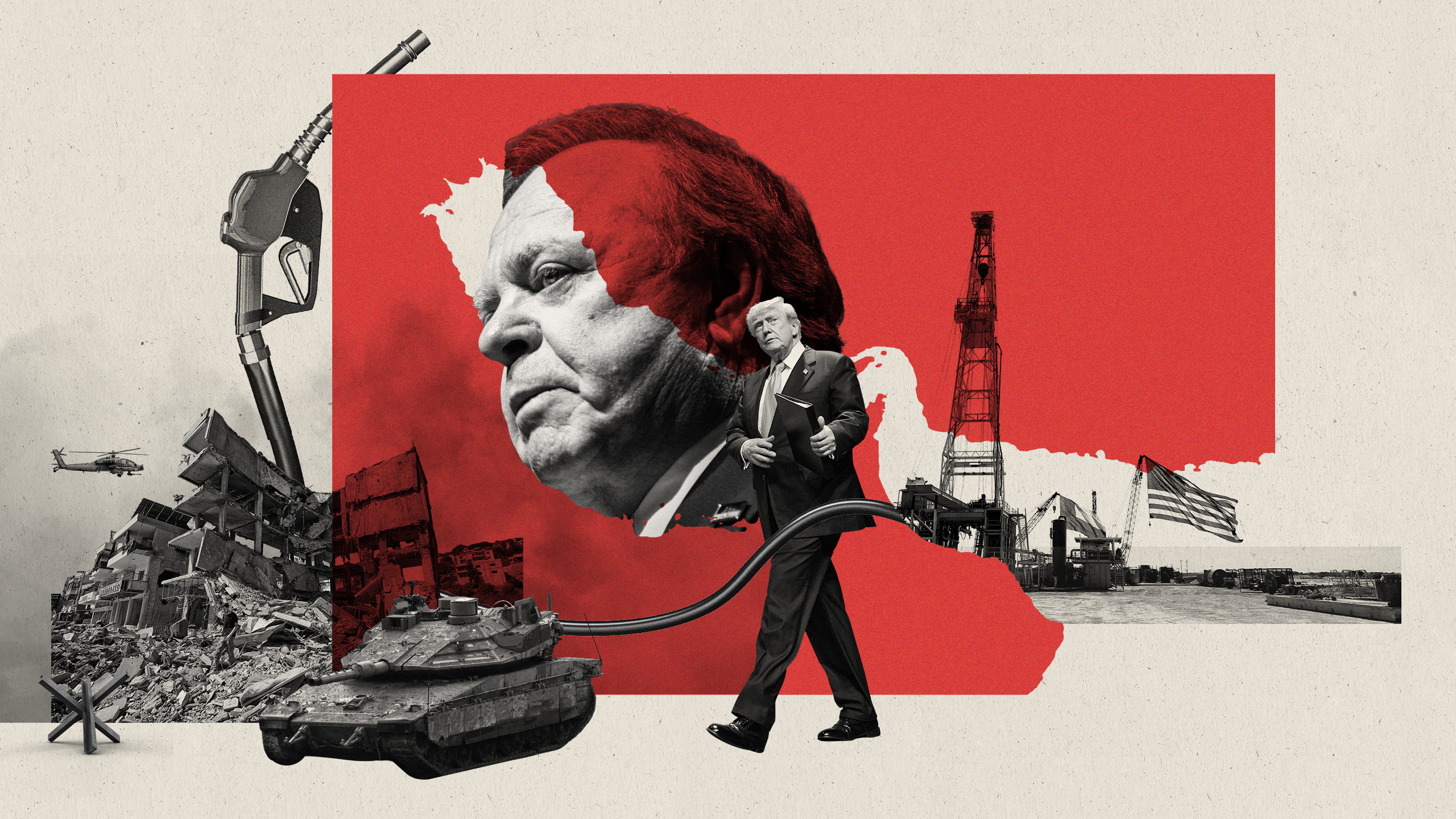
Now, MAGA megadonor and fracking magnate Harold Hamm aims to profit from an energy crisis he assured U.S. officials would never happen.
This past January, U.S. oil billionaire Harold Hamm announced that his company would stop drilling new wells in North Dakota’s Bakken oilfield. It would be the first time this century that Hamm would not have an active rig in the state where he had made his fortune as a fracking pioneer. “There’s no need to drill it when margins are basically gone,” the Continental Resources founder said, as domestic oil prices approached their lowest point since the pandemic.
What a difference four months and a global energy crisis can make.
In May, Hamm reversed course. Instead of taking rigs offline, Continental would boost spending to capitalize on the soaring oil prices caused by the U.S. and Israeli war with Iran. “We’re not giving it away now,” the 80-year-old said at a North Dakota oil summit, as U.S. crude hovered around $100 per barrel, up more than 60 percent since his prior announcement.
It was the first time a U.S. oil company said publicly that it would ramp up production because of the Iran war. But Hamm’s announcement was noteworthy for another reason: The MAGA megadonor had spent years dismissing the risk of the very energy price spikes from which he was now openly hoping to profit.
A close ally and informal adviser to Donald Trump, Hamm had been advocating for the United States to take a hard line against Iran for more than a decade—arguing that America’s abundant oil and gas production meant the United States was free to do so without fear of energy consequences at home. In Hamm’s telling, U.S. oil would protect the U.S. economy “no matter what happens in countries such as Iran.”
As part of his efforts, Hamm relaunched the Council for a Secure America (CSA), a non-profit that declared the Islamic Republic a “looming existential threat” in its founding mission statement.
He enlisted dozens of fellow oilmen to the cause, leading several on a trip to Israel where they met with Prime Minister Benjamin Netanyahu.
He teamed up with influential U.S. neoconservatives and former White House officials, an intellectual architect of the Iraq War among them.
He coordinated closely with former Israeli officials, including the one-time head of research for the country’s military intelligence.
And he worked alongside an advocate for religious Zionism who, after Hamas’s October 2023 terrorist attack on Israel, said that “the Gazan people” are “fundamentally evil, and they must pay a price for their actions.”
Under Hamm’s leadership, CSA made its case to U.S. officials and global dignitaries behind closed doors in board rooms, foreign embassies, and private dining rooms. Among those the group secured facetime with were the two men who now lead Trump’s National Energy Dominance Council and who would advise the president on the energy impact of bombing Iran, Energy Secretary Chris Wright and Interior Secretary Doug Burgum.
In the lead up to the war, Wright and Burgum would both echo Hamm’s views on the global energy market and the Strait of Hormuz, the waterway through which a fifth of the world’s oil previously moved. Trump would later do the same while defending his decision to go to war.
This investigation is based on a review of hundreds of pages of CSA material, as well as public records and other documents obtained by Fieldnotes. Details of Hamm and CSA’s foreign policy advocacy were first reported in partnership with the Guardian.
CSA did not dispute the details of this investigation and declined to answer specific questions about its work. “CSA does not lobby for or against military actions,” executive director Jennifer Sutton said in a statement provided by an outside communications firm. “CSA's mission is to educate on the strategic importance of U.S. energy security, including its role in strengthening domestic economic stability, reinforcing national security, and advancing peaceful geopolitical outcomes through economic prosperity.”
Continental did not respond to a request for comment but Hamm has previously said he is unbothered by the energy price spikes caused by the war. “Even though [the Strait of Hormuz is] bottlenecked up and starving Japan, it’s starving Europe, it’s starving a lot of places for energy, we’re okay,” he said in May at an event in San Francisco, where he was being honored.
The son of Oklahoma sharecroppers, Hamm expressed similar indifference toward Americans who had seen the average price of gasoline climb by more than a dollar per gallon since the start of the war. “I really don’t feel bad,” he said at the same event. “These folks are driving down the road with the $80,000 F-150 and we’re at about $4 gas.”
Hamm, whose estimated net worth is $20 billion, added: "It's all relative."

Trump’s ‘Original Oil Guy’
Hamm was not alone in pushing for the United States to take a hard line against Iran and it is unclear to exactly what degree his views influenced Trump's decision to go to war. The White House declined to comment on the record about whether Hamm ever spoke directly with Trump about Iran but said that the president is “the final decision-maker” and “has been remarkably consistent for years [that] Iran can never be allowed to obtain a nuclear weapon.”
“President Trump makes all policy decisions based on what is best for the American people—which includes unleashing American energy dominance to lower prices for Americans and strengthen our country’s national security,” spokesperson Taylor Rogers said in a written statement. “The media’s continued attempts to fabricate conflicts of interest are irresponsible and reinforce the public's distrust in what they read.”
Public-interest advocates who have tracked Hamm say he’s played an outsized role in Trump’s energy policy dating back to his first campaign. “Harold Hamm very publicly emerged as the oil whisperer in Trump’s ear on all things energy policy,” Tyson Slocum, energy director at Public Citizen, told the Guardian and Fieldnotes. “Hamm speaks a language Trump understands and he shares his general worldview. And I think at the end of the day, that has helped move Trump to places and positions that—if Hamm wasn’t here—Trump wouldn’t have ended up in.”
Trump has described Hamm as a “long time” friend and is said to have called him his “original oil guy” behind closed doors. Hamm has stumped for Trump on the campaign trail, spent more than $2 million on his election efforts, and organized several big-dollar fundraisers, including the Mar-a-Lago meeting in 2024 at which Trump reportedly asked oil executives for $1 billion.
More recently, Hamm held a party on the rooftop of a high-priced hotel that overlooks the White House for Trump’s second inauguration, agreed to help finance the president’s plans for a state ballroom to replace the demolished East Wing, and has made at least two trips to the Oval Office since Trump returned to power. During his last known visit, a January meeting the president called to encourage oil companies to invest in Venezuela, Hamm’s enthusiasm stood in contrast to other executives in the room. Exxon’s Darren Woods called the country “uninvestible”; Hamm called it “very exciting.”
Hamm has benefited from the relationship as well.
Trump selected Wright and Burgum for his top energy posts, a pairing Hamm celebrated as “a dream team of unimaginable proportions.” Continental has also benefited directly from Trump’s tax cuts and specifically from the new federal drilling permits the company has received in Wyoming, where Hamm hopes another fortune lies underground in Converse County.
Further illustrating Hamm’s influence, earlier this year, the U.S. Environmental Protection Agency revoked the scientific finding on which nearly all climate rules rest—a move Hamm’s oil trade group, the Domestic Energy Producers Alliance (DEPA), pushed for even as other oil and gas power players expressed second thoughts about the repeal, which might affect their ongoing efforts to quash climate lawsuits.
While Hamm holds considerable sway among the current administration, his political influence predates Trump’s first term. In 2015, Hamm was among the leaders of the effort to convince Congress to lift the embargo on U.S. oil exports that had been in place for 40 years. That move is a major reason why domestic oil prices now move largely in tandem with global ones, as they have done during the Iran war.
“You cannot extricate the U.S. from the global petroleum economy,” Michael Klare, a Five Colleges professor emeritus who has written extensively about oil and U.S. foreign policy, said in an interview. “If there’s a severing of oil to the rest of the world, even if the U.S. still has plenty, it has consequences that blow back onto the U.S. with higher prices [at home], as well as strategic consequences for U.S. allies.”
Hamm’s critics say he should be well aware of that given his role in lifting the export ban.
“‘Energy dominance’ never actually meant cheaper prices for American consumers—it meant giving Harold Hamm more oil to export to foreign countries,” said Aaron Weiss, executive director of the Center for Western Priorities. “And the Iran war has finally laid that lie bare in a way that Donald Trump cannot explain.”
“No longer is it the case that the flow of oil to the United States will be stifled if the Strait of Hormuz is shut down.” Harold Hamm, November 2, 2018
‘CSA Friends’ and ‘CSA Family’
CSA was originally formed in the 1980s to defend oil industry tax breaks from then-President Ronald Reagan’s push to reform the tax code. One of the group’s first fundraisers was held “on a yacht in New York Harbor,” according to oilman Mike Cantrell, who worked for Hamm both at Continental and DEPA. The “principal speaker” at that fundraiser, Cantrell recalled in an account of CSA’s founding, “was a young Israeli ambassador to the U.N. named Benjamin Netanyahu.”
Netanyahu would meet with CSA again after Hamm relaunched the group in 2012. In February 2013, Hamm and other council members took a three-day trip to Israel, where they visited the Western Wall, toured a military base, and met with Netanyahu, who since his CSA fundraising speech had become Israel’s prime minister. The trip was documented by contemporaneous local news reports and supported by photographic evidence previously hosted on CSA’s website and archived by Fieldnotes. While in Israel, Hamm said that America would no longer need “to kowtow to countries just due to the fact that they have oil production.”
Registered as a public charity, CSA is legally barred from devoting a substantial part of its activities to lobbying or from campaigning for a candidate. A self-described “alliance between the American oil and gas industry and the pro-Israel community,” the current version of CSA is stocked with individuals influential both within Trump’s orbit and on the world stage. Among them are the leaders of more than a dozen oil and gas trade groups, including Dustin Meyer, a senior vice president at the American Petroleum Institute, the industry’s most powerful lobby and a well-known force in Washington.
Other CSA directors or advisors include Elliott Abrams, a long-time neoconservative who was convicted of lying to Congress as part of the Iran Contra affair, was one of the intellectual architects of the Iraq War, and later served as Trump’s special representative to Iran and Venezuela during his first term; Mike Pompeo, Trump’s former secretary of state; Evan Bayh, the former Democratic senator and governor of Indiana; Yossi Kuperwasser, an Israeli reserve brigadier general who previously led research for his country’s military intelligence; and Martin Oliner, the chairman of Religious Zionists of America.
In the weeks before the war began and as Trump amassed U.S. military forces in the Persian Gulf, Kuperwasser hoped openly for regime change in Iran. “Failure to recognize [the opportunity]—or to act accordingly—would not preserve stability,” he wrote in an international affairs journal. “It would postpone confrontation at a higher cost.”
Oliner, who Trump appointed to the Holocaust Memorial Council during his first term, has drawn criticism for his rhetoric about Palestine. Following Hamas’ terrorist attacks on Israel in 2023, Oliner wrote an op-ed suggesting that “the Gazan people” are “fundamentally evil, and they must pay a price for their actions.” Speaking at an event at a pro-Israel think tank in 2024, Oliner told an Israeli official: “We’re being accused of genocide, but maybe we need to kill more civilians.”
CSA has also cultivated an informal roster of allies it refers to internally as “CSA friends” and "CSA family," four of whom currently serve in the Trump administration, including Wright. Before joining Trump’s cabinet, Wright was CEO of Liberty Energy, an oil services company, and a director of the Hamm-led DEPA. Wright’s successor at Liberty, Ron Gusek, is now a director at CSA and also sat on DEPA’s executive board before it merged with the Independent Petroleum Association of America in early July of this year.
"We don't use the strait—the United States, we don't need it." President Donald Trump, March 20, 2026
‘War Reports’ and ‘Off-the-Record’ Meetings
Hamm has been downplaying the importance of the Strait of Hormuz to the global and domestic energy markets since at least 2018. That year, in an essay he co-wrote in National Review supporting sanctions against the Islamic Republic, Hamm predicted that the United States would be “capable of providing enough oil to help stabilize the global market, no matter what happens in countries such as Iran.” He added: “No longer is it the case that the flow of oil to the United States will be stifled if the Strait of Hormuz is shut down.”
Following Hamas’s 2023 attacks, CSA’s efforts increased in frequency and force. The council launched a “War Room” and began issuing “War Reports” that highlighted Iran’s ties to Hamas and Hezbollah and warned that Iran’s proxies might commit acts of terrorism on U.S. soil. In 2024, the group began commissioning polls in red states it said showed support from “American voters” for “US military engagement in the region.” That same year, CSA co-chair Matt Most asserted, "Because of the strength of our energy production we cannot be leveraged by our enemies or punished for defending our allies through energy ransom.” And after the U.S. and Israel bombed Iran in June 2025, CSA executive director Jennifer Sutton declared the conflict “a defining test of Western resolve in the face of authoritarian aggression."
CSA had ample opportunity to deliver their message to officials at home and abroad. The group’s annual reports show that in the 30 months between Hamas’s 2023 attacks and the start of the Iran War, the council held at least 300 congressional briefings with lawmakers and their staff, dozens of “high-level” discussions with U.S. and Israeli security experts, and a series of “off-the-record” meetings with global dignitaries, including Israel’s ambassador to the United Nations, Danny Danon.
Council members met with Wright and Burgum on at least four occasions during that time, including at a private dinner in North Dakota in May 2024 that the latter hosted when he was the state’s governor. Public records show that Hamm, Burgum, Wright, and Wright’s wife made up half of those seated at the head table at the event, where guests dined on walleye cakes, a beef entree, and peach cobbler, and wine and beer were supplied by Ron Ness, the president of the North Dakota Petroleum Council and a CSA partner. At least three other CSA members, including Sutton, were also in attendance. Later that year, Sutton appears to have met with Burgum's then-chief of staff Jace Beehler.
Wright held at least two in-person “off-the-record” meetings and one virtual briefing with the council during that same period, including once after becoming energy secretary. That meeting occurred at the Argentine embassy in Washington, D.C., in May 2025, according to CSA’s most recent annual report. (In November of that year, Continental signed a deal to buy assets in Argentina's Vaca Muerta shale basin; Continental CEO Doug Lawler has called the basin "one of the most compelling shale plays in the world.")
As is the case with Trump, it is unclear whether Burgum and Wright were convinced by CSA to adopt Hamm’s view on the importance of the strait or if they already shared it. The Energy and Interior departments both did not respond to a request for comment. But in the lead up to the war, both men would echo Hamm’s prediction that the nation’s purported energy independence meant it would not pay an economic price for a war in the Middle East.
Speaking at a conservative think tank this past fall, for instance, Burgum recalled the president asking his team ahead of launching strikes on Iran’s nuclear facilities in 2025 what impact that bombing would have on energy prices at home. “Well, you know what the advisers had an opportunity to say?” the interior secretary said. “‘Nothing.’ Nothing at all. It's not going to change the price of the pump, because guess what? The U.S., we don't get any oil anymore out of the Strait of Hormuz.”
Less than a month before Trump started the war, Wright offered a similar assessment. “The world is very well supplied with oil right now, and I think it gives President Trump more leverage in his geopolitical actions to not worry about a crazy spike in oil prices,” the energy secretary said in a television interview.
The president struck the same note during the first month of the war. "We don't use the strait—the United States, we don't need it,” Trump said outside the White House on March 20. The week before, he had said that because the United States is the world’s largest producer of oil “when oil prices go up, we make a lot of money.”
Oil prices briefly returned to pre-war levels after last month’s temporary U.S.-Iranian truce was announced but have risen again as both sides continue to exchange military strikes in the region. Researchers at Brown University estimate that Americans have paid an additional $69 billion and counting for fuel than they otherwise would have if the United States had not gone to war with Iran and the strait had never been closed.
Some portion of that spending has gone to Continental. If Hamm has his way, more will follow.
Sign up for our free newsletter on Substack
By subscribing you agree to our Privacy Policy